
Phurba Pendant – Vajrakilaya Ritual Dagger in Sterling Silver
Pure Silver Edition / Titanium Bead Chain
$770.00
Skip to product information


Phurba Pendant – Vajrakilaya Ritual Dagger in Sterling Silver
$770.00
Free shipping · Duties paid · 30-day returns
Hand-carved S925 silver · 24K fire-gilded · Engraved under a 40× microscope
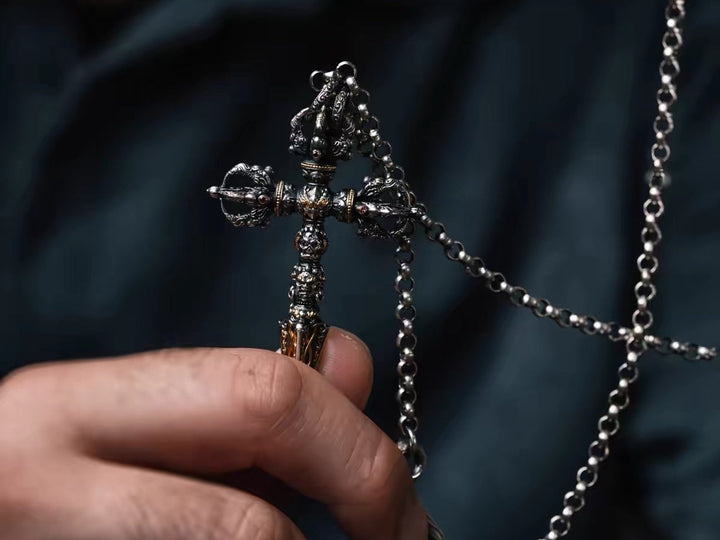
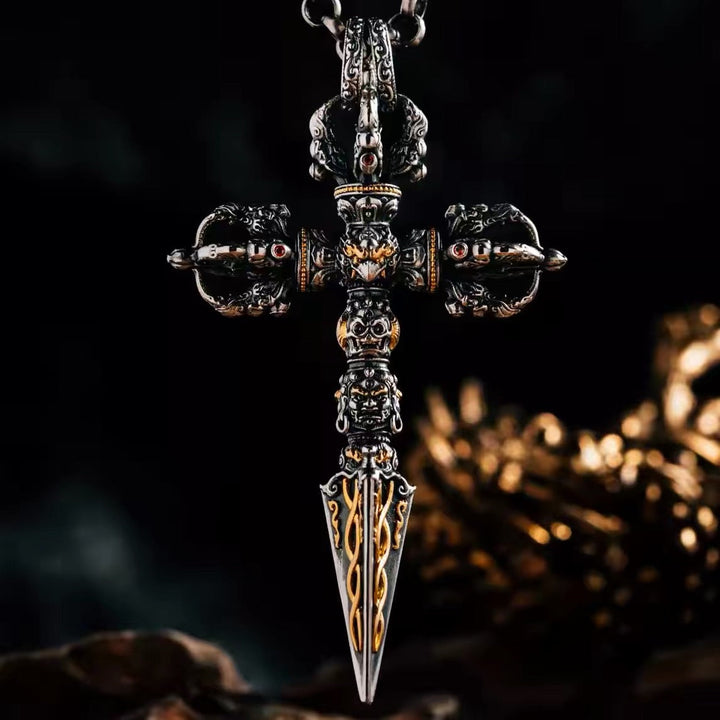
A three-sided ritual dagger in S925 silver, after a Ming-dynasty form: crossed vajra crown, three wrathful heads stacked down the handle, and a blade issuing from a makara's jaws with serpents along all three faces. Made in silver alone, or fire-gilded in 24K with natural garnets in the crown.
Size & details
- Material
- S925 sterling silver, hand-carved, oxidised
- Gold
- 24K on the Fire-Gilded Edition: garuda, collars, flames, serpents
- Stones
- Natural garnets in the crown (Fire-Gilded Edition only)
- Editions
- Pure Silver, or 24K Fire-Gilded with garnets (+$200)
- Size
- 65 × 40 × 12 mm (2.6 × 1.6 × 0.5 in)
- Weight
- 20 g / 0.7 oz
- Chain
- 65 cm / 25.6 in titanium bead chain included; silver chain with garuda S-hook +$300
Design
Editions
Pure Silver Edition — S925 sterling silver, no gold and no stones. Every head, prong and serpent is the same as on the gilded piece; only the gold is absent. With nothing bright to lead the eye, what holds it up is the cutting itself.
24K Fire-Gilded Edition — the same carving, with 24K gold fused into the silver by fire: across the garuda's face at the crossing, around the beaded collars, into the flames and faces down the handle, and along the serpents that twist down all three faces of the blade. Natural garnets are set by hand into the makara heads of the crossed vajra crown. Against the darkened silver the gold picks out the whole structure of the object, from crown to point.
Chain
Titanium Bead Chain — included with either edition, approximately 65 cm / 26 in. Light, strong, and quiet against the skin.
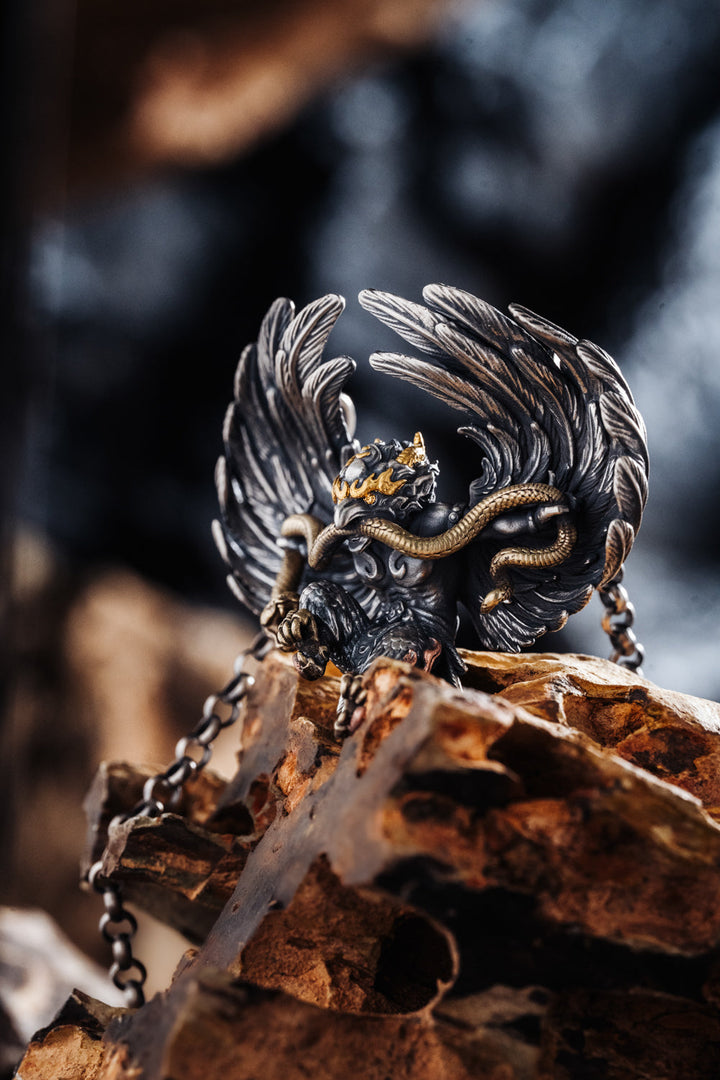
Silver Chain with Garuda S-Hook — a silver chain that closes on a carved S-hook with garuda and vajra-head ends, so the carving carries on past the pendant and into the clasp.
A phurba is not a knife. It has three faces and no cutting edge, and it was never meant to slice anything. It is a stake. You drive it down, and what it pins does not get up again.
What it pins is not a person. In the tradition it is whatever in you keeps coming back — the anger you thought you had finished with, the wanting that returns wearing a new coat, the not-seeing that makes both of them possible. Three faces on the blade because there are three of them, and they are taken down together or not at all.
1. The Ming form, not a modern one. The proportions follow a phurba type that came down from the Yongle era of the Ming — the period when the imperial workshops were producing Tibetan ritual bronzes at a level that has never really been matched since. Those pieces sit in museums now. We did not reinterpret the shape or streamline it. We took the old proportions and built to them.
2. Four prongs: square earth, round heaven. The handle is built on a four-pronged structure — four, for the four directions, the squared earth underfoot. The arc the prongs describe as they curve back in is the circle of heaven closing over it. The oldest cosmology in this part of the world, carried in the grip rather than written anywhere.
3. Three heads, stacked down the handle. Where most hands would put a plain shaft, there are three faces, one above the other, each one carved separately and each one wearing a different expression. They are named below.
4. The blade has three faces and no edge. This is what makes a phurba a phurba. A triangular section, tapering the whole way to a single point. It cannot cut. It can only go down, and hold.
5. Serpents bound into the blade. Along all three faces, nagas run in low relief, twisting around one another the length of the taper. On the old ritual pieces the serpents are shown bound to the blade — the poison brought under the thing that subdues it, carried rather than destroyed.
6. The blade comes out of a mouth. At the junction, the taper emerges from the jaws of a makara. The blade is not fitted to the handle. It is being born out of it — which is the older and more difficult way to model the transition, because the two forms have to flow through each other with no seam anywhere.
7. Beaded bands between every section. Crown to prongs, prongs to first head, head to head, head to makara: every joint is marked with a line of raised grains, each grain cut individually. They are the smallest things on the piece and there are more of them than of anything else.
8. Nothing is plain, anywhere. Turn it over. The scroll and cloud work runs around the full body of the handle, the reverse faces of the blade are carved to the same depth as the front, and even the bail is cut with its own pattern. There is no back on this object.
The Three Heads
Garuda — at the top. The bird that eats serpents and is born already able to fly. In the Himalayas he is what you call on when the poison is the kind that has no antidote: illness that came from nowhere, malice you cannot trace, fear with no object. Garuda does not negotiate with any of it. He swallows it.
The Lord of the Charnel Ground — in the middle. The protector who keeps watch over the cremation ground, the one place where nobody can pretend any longer. His face is not there to frighten you. It is there to remind you what is actually true, which is the one thing that makes a person hard to frighten.
Vajrakilaya — at the base, where the handle becomes the blade. The wrathful one whose own body is this dagger. He is not holding the phurba; he is the phurba, and the point at the bottom is the point of him. Of all the wrathful forms, he is the one invoked when something has to be finished rather than managed.
The Meaning
Wrathful is the most misread word in this tradition.
These faces are not angry at you. In Tibetan iconography, wrath is what compassion looks like when patience has stopped being useful — when the kind approach has been tried for years and the thing is still there. There are situations a gentle face cannot reach. These three are for those.
So the phurba is not a weapon and not a decoration. It is a reminder, in silver, that some things in a life do not get talked round, or waited out, or gently encouraged to leave. They get pinned.
May what needs ending in you be ended cleanly, and stay ended.
Materials & craft
S925 sterling silver, carved by hand. Gold accents are traditional 24K fire-gilding, bonded into the silver at around 900 °C, not plated. Stones are natural and called by their real names.
Every piece is designed and handmade in China and finished by hand under a 40× microscope. How fire-gilding works
Shipping & duties
Free tracked shipping to 47 countries, with all import duties and taxes paid by us. The total at checkout is the total you pay.
Orders ship in 1–3 business days (engraved pieces take about 3 more) and travel with YunExpress in 5–8 business days, so most arrive within about two weeks.
Returns & lifetime care
30-day returns from delivery, with no restocking fee. Ring sizes can be exchanged within 30 days. Engraved pieces, consecrated pieces and the Nine-Palace Zodiac Amulet are final sale unless they arrive faulty, damaged or not what you ordered.
Free lifetime care: send a piece back at any time and we will clean it, polish it and check every setting for free. You only pay the postage to us.
From the bench
How every piece is made
The gold on every piece goes through four stages, each one done by hand.
Swipe to follow each stage
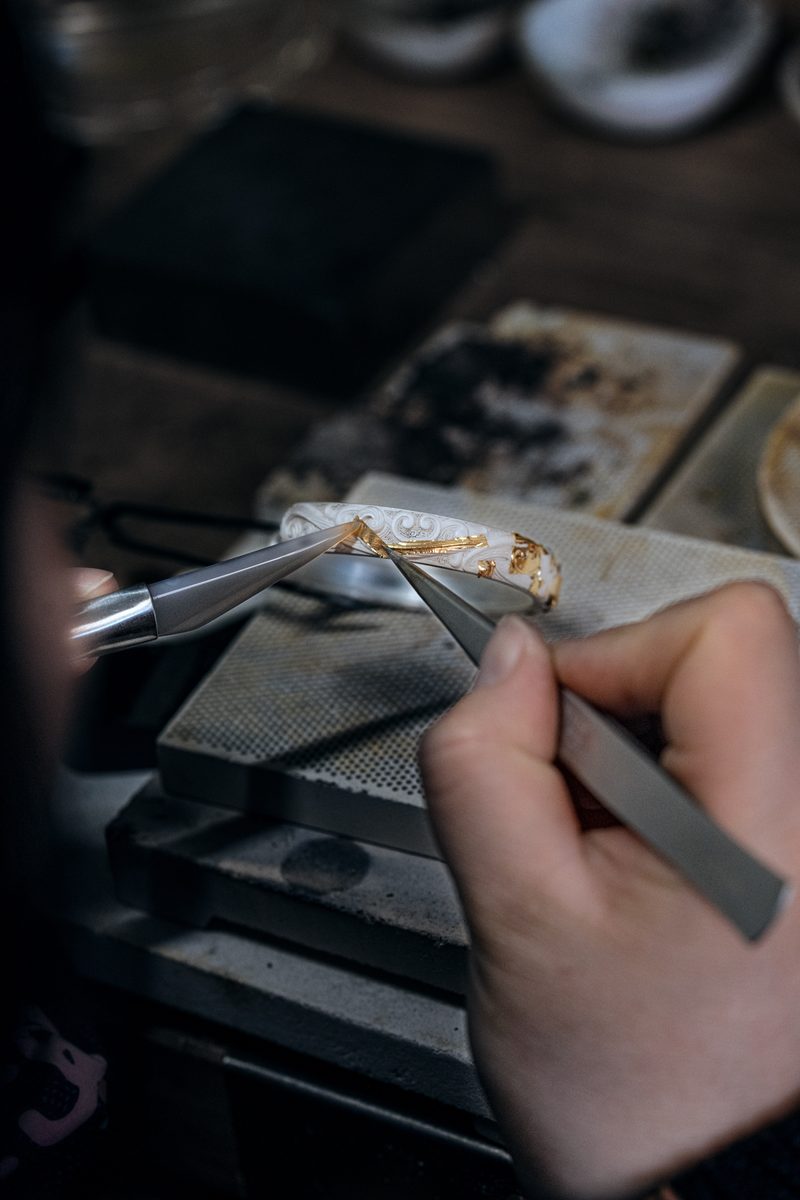
01
Gold leaf, laid by hand
The gold is 24K leaf, thick enough to pick up with tweezers. It is laid onto the silver in small pieces, one section of the carving at a time, and pressed down with a burnisher.
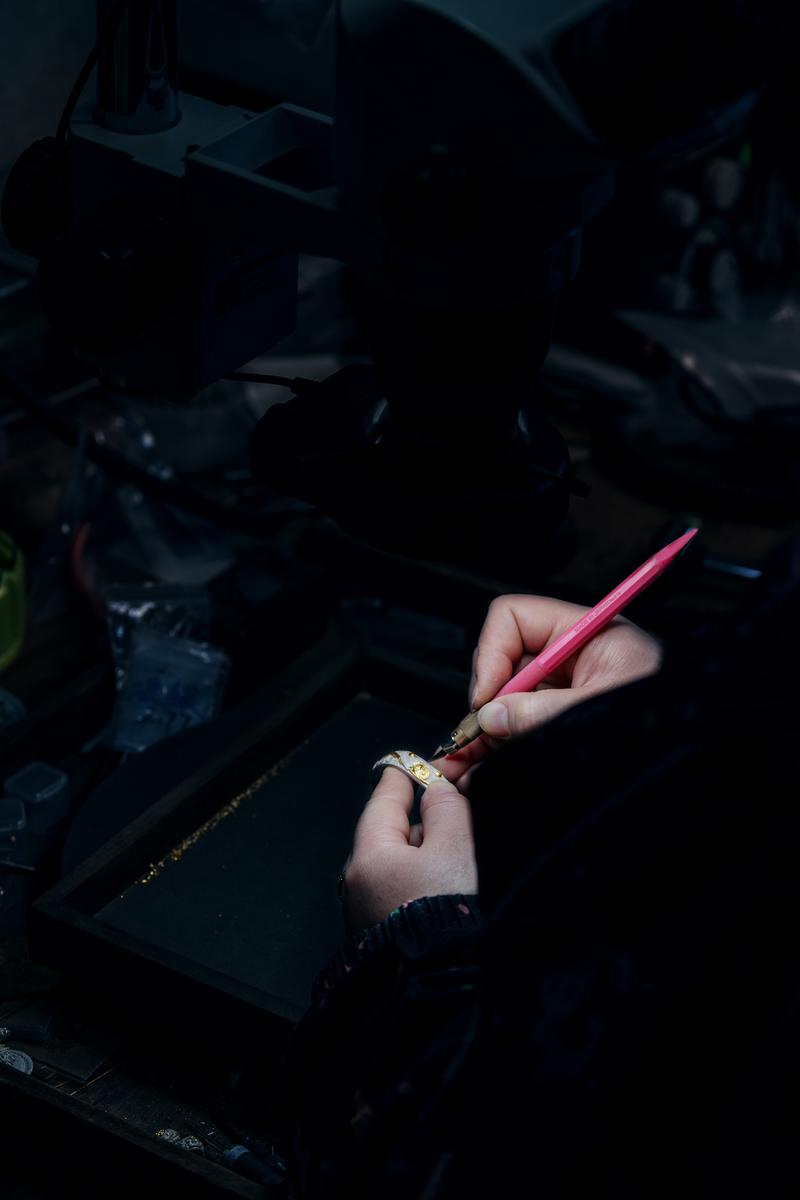
02
Cut under a 40× microscope
Every line is cut with a hand graver. The finest parts, an eye, a whisker, the edge where gold meets silver, are worked under a 40× microscope, where a slip of a tenth of a millimetre would show.
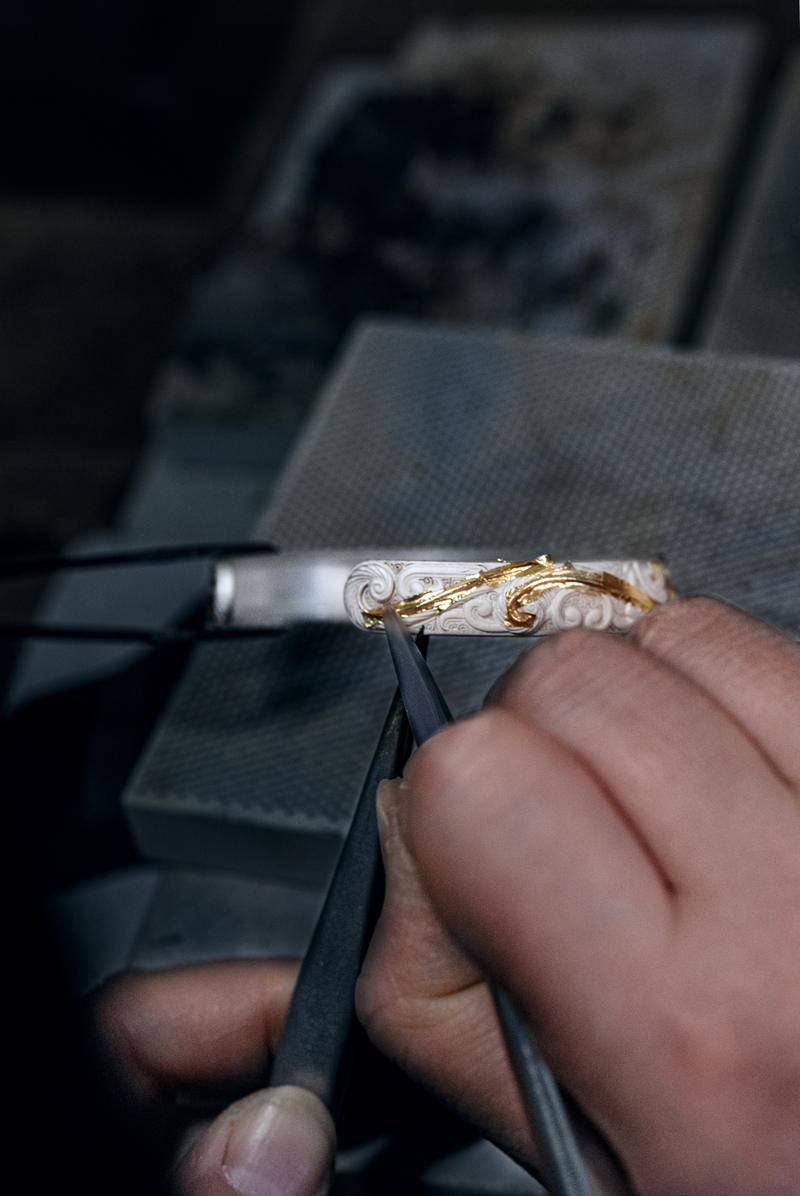
03
Gold only where it belongs
The leaf is worked along each scroll until it follows the carving exactly. Gold goes only where the design asks for it. The rest of the silver is left bare, to be darkened later so the carving reads.
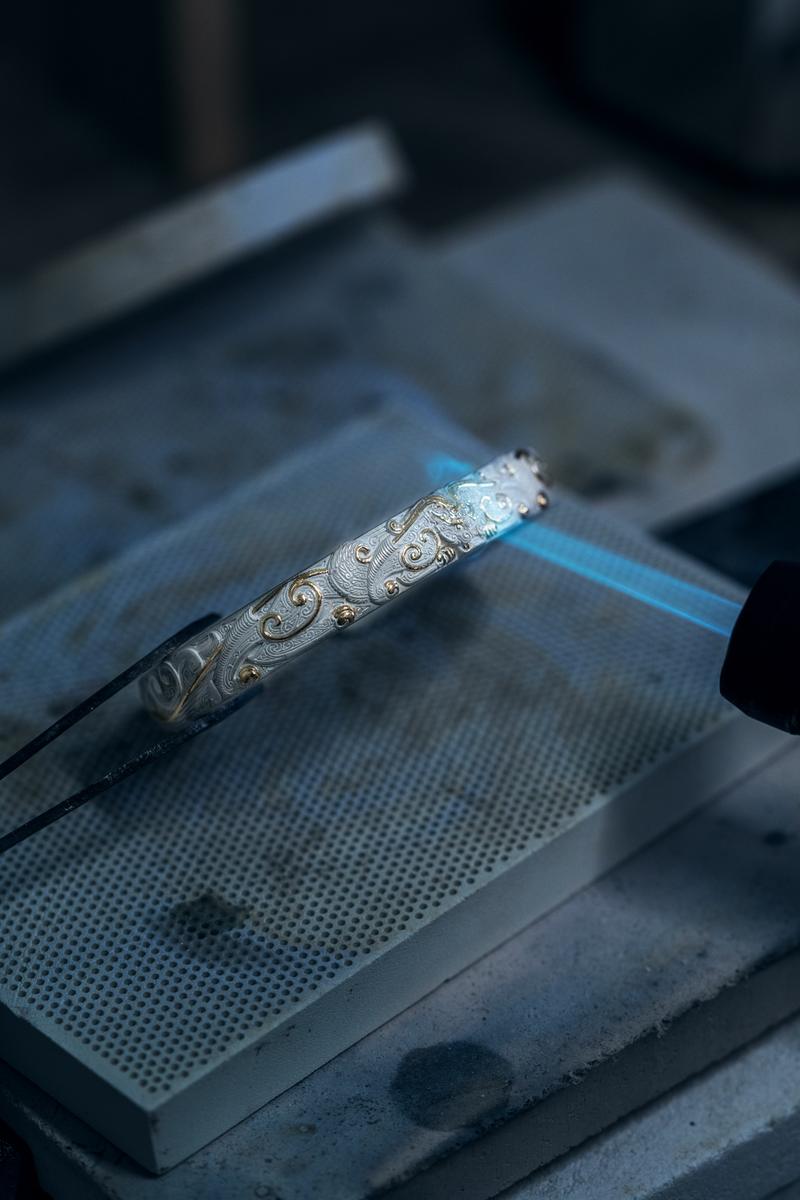
04
Fused by fire at 900°C
Then the torch. At around 900°C, below gold's melting point of 1063°C, the leaf bonds into the silver and becomes part of it. The heat is judged by eye, one area at a time: too cool and the gold lifts later, too hot and the carving underneath is lost.
Afterwards every gilded edge is cut again under the microscope. This is fire-gilding, not ordinary gold plating.
Free Tracked ShippingDuties and taxes paid, 47 countries
30-Day ReturnsFull refund, no restocking fee
Free Ring Size ExchangeWithin 30 days of delivery
Lifetime CareFree cleaning and polishing
Fire-Gilded by HandFinished under a 40× microscope
From the Journal
The story behind it
Frequently asked questions
How long does delivery take?
Every piece is held in stock and ships within 1–3 business days (engraved pieces need about 3 more). Delivery with YunExpress then takes 5–8 business days, so most orders arrive within about two weeks. We email your tracking number as soon as the package leaves us.
Will I have to pay import duties or taxes?
No. We pay import duties, taxes and customs fees for every country we ship to. The total at checkout is the total you pay. If a carrier ever asks you for duty, don't pay it; email us and we will settle it.
What is fire-gilding, and how is it different from gold plating?
Gold foil is fused into the sterling silver by heat at around 900°C, then every edge is re-cut by hand under a 40× microscope. The gold becomes part of the piece, a real weight of 24K gold rather than the thin film of ordinary gold plating, so it does not lift, flake or wear thin. More on fire-gilding
Why is the silver dark in places?
The dark recesses are oxidation, added on purpose so the carving reads clearly. It is not tarnish. A soft dry cloth on the raised surfaces is all the cleaning it needs; please don't use silver dip or polishing compound, which would strip the shading.
Can I return or exchange a piece?
Yes. Email us within 30 days of delivery and you can return a piece in the condition you received it for a full refund, with no restocking fee. Rings can be exchanged for another size within 30 days. Engraved pieces, consecrated pieces and the Nine-Palace Zodiac Amulet are final sale unless they arrive faulty, damaged or not what you ordered. Refund policy
How do I find my ring size?
Measure the finger you will wear it on, at the end of the day, and make sure the size clears your knuckle. Our ring size guide has a US size chart and two easy ways to measure at home.
Can I wear it in water?
It depends on the piece. Pieces set with natural stones should come off before swimming or bathing and be wiped dry after contact with water. Each product page lists its stones and its own care notes.
How can I pay?
Checkout is through PayPal, where you can pay with your PayPal balance or with a credit or debit card. Prices are in US dollars.